
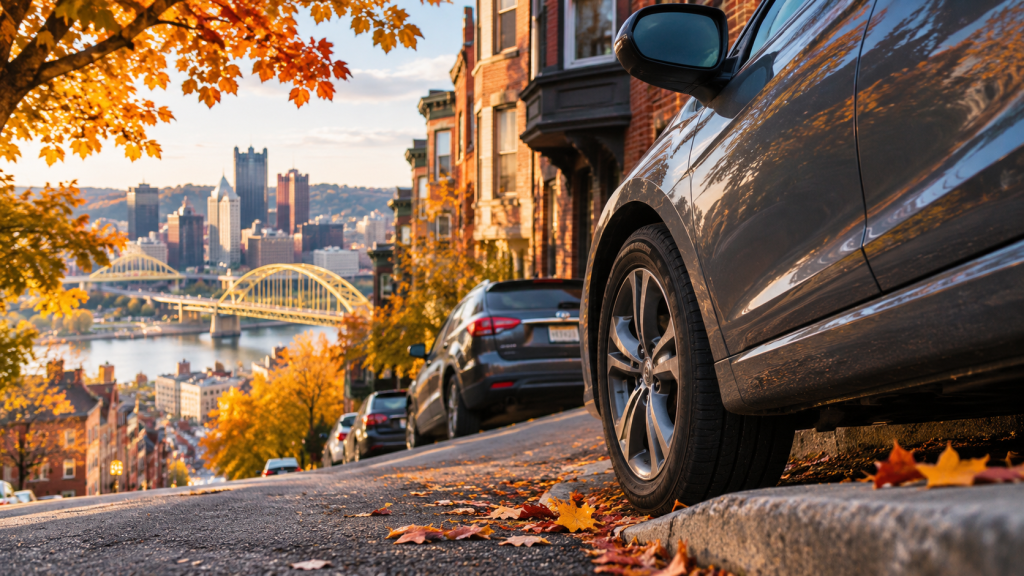
In Pittsburgh, parking on a hill is not a special occasion. It is part of everyday life. Streets climb steeply, driveways tilt, and plenty of residents have no choice but to leave their cars on a slope overnight. On a flat road, a weak parking brake might go unnoticed for years. On a hill, it can be the only thing standing between your parked car and a roll down the street. This guide explains what the parking brake does, how to tell whether yours is weak, why it matters so much on steep streets, which parts commonly fail, how to park safely on a slope and how repairs usually work. If you are searching for parking brake repair in Pittsburgh, or you have an emergency brake that is not holding, here is a plain language overview.
What the Parking Brake Does
The parking brake, often called the emergency brake or handbrake, is a separate braking system from your regular brakes. Your regular brakes use hydraulic fluid pressure, controlled by the pedal. The parking brake works mechanically on most cars, using a cable that pulls on the rear brakes when you lift a lever, press a pedal or push a button. Some newer cars use an electronic parking brake, which applies the brakes with a motor and a switch rather than a cable.
Its main job is to hold the car in place when it is parked. It is not meant to be the main way to stop a moving car, though it can be a backup in some situations, and your owner’s manual explains how your car’s system works.
Why a Weak Parking Brake Matters More on Hills
- Gravity does the work for you. On a steep street, a car has a constant pull downhill, and the brake must resist it for hours.
- The transmission is not enough. Putting an automatic car in park uses a small metal pin inside the transmission to lock the output. On a steep hill, that pin carries the whole weight of the car, and it can wear or fail. The parking brake takes that load instead.
- The stakes are higher. A car that rolls can hit other cars, damage property or injure someone.
- It is also used for hill starts in some manual cars.
- It may be tested by inspections. Many drivers find out their parking brake is weak only at that point.
Signs Your Parking Brake Is Weak
- The car moves or creeps when parked on a slope with the parking brake on.
- The lever or pedal travels too far. A handbrake that rises much higher than it used to, or a pedal that sinks nearly to the floor, can point to stretched cables or worn brake parts.
- The lever feels loose, soft or lacks resistance.
- The brake does not hold even at the end of its travel.
- The lever or pedal is very stiff or stuck, which can point to a seized cable.
- The brake does not release, and the car drags or the rear wheels feel hot after driving.
- A parking brake warning light stays on after you release the brake.
- A burning smell or smoke from a wheel after driving with the brake partly applied.
- Grinding or squealing noises from the rear brakes.
- A clunk or a jolt when the electronic parking brake applies or releases, or an error message.
A Simple Check You Can Do
You can run a basic check, but do it safely. On a gentle, clear slope with no traffic and no people or vehicles below, set the parking brake, shift to neutral and ease your foot off the service brake, while remaining ready to press it again right away. If the car moves, the parking brake is not holding, and you should get it checked. Do not test on a steep hill, and never do it with anyone behind or in front of the car. If you are not comfortable, ask a technician to test it.
Why Parking Brakes Fail
- Stretched or corroded cables. Cables stretch with use and can rust or seize, especially in a place with wet, salty winters.
- Worn rear brake pads or shoes. The parking brake often uses the same friction material as the rear brakes, so wear can reduce its holding power.
- Seized or sticking parts. Calipers, levers and cables can stick when rust and dirt build up.
- Misadjustment. Many systems have an adjustment that can drift or be done incorrectly.
- Rarely used parking brakes. A brake that is never applied can seize or rust, and one that is used all the time wears faster.
- Frozen cables in winter. Water in a cable housing can freeze and keep the brake from releasing.
- Electronic system faults. A failing motor, wiring problem, sensor or software problem can keep an electronic parking brake from applying or releasing.
- Broken or damaged parts. A snapped cable or a broken lever can leave you with no holding power at all.
How Pittsburgh Streets and Winters Add Wear
Steep grades put heavy demands on every brake component, which is why hills accelerate brake wear in general. Our guide on how hills wear out your brakes explains what is happening, and the same factors affect the parts connected to your parking brake. Winters add moisture, road salt and freeze and thaw cycles that attack cables and fittings. Our article on what Pittsburgh’s bridges, hills and winters do to your car covers the bigger picture of how local conditions wear on a car.
How to Park Safely on a Hill
Using the parking brake is only one part of safe parking on a slope. General guidance often includes the following, and your owner’s manual and local rules are the best source for your situation.
- Stop the car with the regular brakes and keep your foot on the pedal.
- Apply the parking brake firmly before you shift to park or turn off the engine, so the brake, and not the transmission, holds the car.
- Shift into park on an automatic, or into first gear or reverse on a manual, as the manual suggests.
- Turn the wheels so that if the car did roll, the curb would help stop it. When facing downhill, many drivers are taught to turn the front wheels toward the curb. When facing uphill with a curb, they are taught to turn them away from the curb, so the tire catches the curb. Without a curb, they are taught to turn them toward the edge of the road.
- Turn off the engine, and make sure the car is secure before you leave.
- When leaving, start the engine, press the brake pedal, shift out of park and then release the parking brake, so the car does not lurch.
Never leave a car on a hill relying on park alone. If the parking brake is weak, avoid parking on steep slopes until it is fixed, and consider using wheel chocks as a temporary precaution.
Electronic Parking Brakes
If your car has an electronic parking brake, the repair and release procedures differ. Do not force a stuck electronic brake or try to disconnect parts yourself. The system often needs a scan tool for service, such as putting the brake into a service mode before replacing rear pads. Your owner’s manual explains the correct way to use and release it, and what the warning lights mean.
What a Technician Checks
- The lever or pedal travel and the feel.
- The cables, for stretching, rust, fraying and sticking.
- Rear brake pads, shoes, rotors and drums, for wear and damage.
- Calipers and hardware, for sticking or seizing.
- The adjustment, and whether the system holds on a test.
- For electronic systems, codes, the motor, wiring and sensors.
Common Repairs
- Adjusting the parking brake where the design allows.
- Replacing stretched, seized or broken cables.
- Replacing rear pads, shoes, rotors or drums.
- Servicing or replacing calipers and hardware.
- Repairing or replacing the lever, pedal or switch.
- Diagnosing and repairing electronic parking brake parts.
Ask the technician to explain what was found and to test the parking brake on a slope after the repair, if it is safe to do so.
Can a Mobile Mechanic Fix a Parking Brake?
Often, yes. A mobile mechanic can come to your home or workplace in Pittsburgh, inspect the parking brake, test how it holds and handle many repairs, such as adjustments, cable replacement and rear pads or shoes, on site. Other work, such as a seized caliper, drum brake problems that need special tools, damaged parts under the car or a complex electronic system, can take more time and may be better done in a shop. A good technician will tell you honestly what can be done where you are. Because the parking brake is a safety item, do not put off the repair.
How to Keep Your Parking Brake in Good Shape
- Use it regularly, as your owner’s manual recommends, which helps keep it from seizing.
- Have it inspected when your rear brakes are serviced.
- Fix problems early. A parking brake that is a little weak can get much worse.
- Rinse the underside of the car in winter to remove salt.
- Release it fully before driving, and do not drive with it partly applied.
- Do not rely on park alone on steep streets.
Quick Summary
- The parking brake is a separate system that holds the car when it is parked.
- On steep streets, it carries the load that park alone should not.
- Signs of weakness include a car that creeps, too much lever or pedal travel and warning lights.
- Cables, rear brake parts and rust are common causes, and winter can make it worse.
- Park safely by applying the parking brake before shifting to park and turning the wheels.
- Many repairs can be done at your home, while some need a shop.
A parking brake you can trust makes every hill a little less stressful. If you would like help, visit the Mobile Mechanic Pros of Pittsburgh homepage to learn more, or contact us to schedule a visit.